Slideshow of us at St Anne's

Tuesday, December 7, 2010

“Eve” by Madeleine L’Engle

Eve and Mary* by Sr. Grace Remington, O.C.S.O

“Eve” When we left the garden we knew that it would be forever. The new world we entered was dark and strange. Nights were cold. We lay together for warmth, and because we were afraid of the unnamed animals, and of the others; we had never known about the giants, and angels gone wild. We had not been told of dwarves and elves; they teased us; we hid whenever they played.

Adam held me. When my belly grew taut and began to swell I didn’t know what was happening. I thought it was the beginning of death, the very first death. I clung to Adam and cried. As I grew bigger something within me moved. One day I fell and the pains started. A true angel came and pushed the grinning creatures back. Adam helped. There was a tearing. I thought I’d died. Instead, from within me came a tiny thing, a new creature, red-faced, bellowing, mouth groping for my breast. This was not death, but birth, and joy came to my heart again. This was the first-born child. How I did laugh and sing! But from this birth came death. He never gave me any rest. And then he killed his brother. Oh, my child. Oh, my son Cain. I watched from then on over every birth, seeing in each babe cruelty ready to kill compassion. For centuries the pattern did not change. Birth always meant death. Each manchild who was born upon the longing earth in gratefulness and joy brought me only a fresh ration of tears. I had let hate into the world with that first breath.

Yet something made me hope. Each baby born brought me hurrying, bringing, as in the old tales, a gift looking – for what? I went to every slum and cave and palace seeking the mothers, thinking that at least I could warn their hearts. Thus perhaps the balance might shift and kindness and concern replace self-will and malice.

So I was waiting at that extraordinary intersection of Eternity and Time when David’s son (Adam’s, too) was born. I watched the Incarnate at his mother’s breast making, by his humble, holy birth the one possible correction of all that I by disobedience had done. I knelt and saw new Adam, and I cried, “My son!” and came at last to rest. — Madeleine L’Engle

Poem Source: Magnificat Magazine

*Eve and Mary, reprinted with the permission of Our Lady of the Mississippi Abbey. For background on the image, and link to a lovely choral piece which grew from it see here.

Monday, November 29, 2010

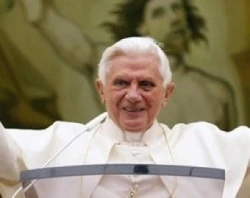
Pope Benedict heralds beginning of Advent with pro-life vigil

On Saturday 26th November at 4:30pm St Anne's hosted First Vespers of the First Sunday of Advent joining His Holiness the Pope in his Pro-Life Vigil. The Recitation of the Divine Office office was attended by the sisters of the Holy Cross Provincialte and some parishioners.

.- Pope Benedict XVI heralded the beginning of Advent this year with an unprecedented worldwide pro-life vigil. On Saturday night at St. Peter's Basilica in Rome, he urged respect for human life and warned against adult “selfishness” and the “darkening of consciences” in modern society.

On Nov. 27, St. Peter's was the center of global focus, as dioceses around the world joined the Pope's invitation to prepare for the season of Christmas by joining in a special Vespers service for the unborn.

Although it is common for the Pope to encourage prayer for particular intentions, the request for a coordinated worldwide vigil – to be held on the same date and approximately the same time, in all dioceses – is highly exceptional.

Pope Benedict began his homily saying that God became a child to experience the life of man in order to “to save it completely, fully.”

“The beginning of the liturgical year helps us to relive the expectation of God made flesh in the womb of the Virgin Mary,” he said, adding that the “Incarnation reveals to us, with intense light and in an amazing way, that every human life has an incomparable, a most elevated dignity.”

Because “God loves us so deeply, totally, without distinction,” the Pope noted that belief in “Jesus Christ also means having a new outlook on man, a look of trust and hope.”

Humankind, therefore, “has the right not to be treated as an object of possession or something to manipulate at will, not to be reduced to a mere instrument for the benefit of others and their interests,” he said.

“In this vein we find the Church's concern for the unborn, the most fragile, the most threatened by the selfishness of adults and the darkening of consciences,” the Pontiff added.

He then reiterated the Church's stance against abortion, warning against “cultural tendencies that seek to anesthetize consciences with misleading motivations.”

“With regard to the embryo in the womb, science itself highlights its autonomy capable of interaction with the mother, the coordination of biological processes, the continuity of development, the growing complexity of the organism,” he said. “This is not an accumulation of biological material, but a new living being, dynamic and wonderfully ordered, a new unique human being.”

“So was Jesus in Mary's womb, so it was for all of us in our mother’s womb.”

Pope Benedict went on to say that even after birth, children around the world face abandonment, hunger, poverty, disease, abuse, violence or exploitation.

“I urge the protagonists of politics, economic and social communications to do everything in their power to promote a culture which respects human life, to provide favorable conditions and support networks for the reception and development of life,” he said.

The Pope concluded by entrusting prayers for the unborn to the Virgin Mary, “who welcomed the Son of God made man with faith, with her maternal womb, with loving care, with nurturing support and vibrant with love.”

Tuesday, November 16, 2010

Our Holy Father Benedict XVI Urges the Whole World to Unite in a Prayer Vigil for All Nascent Human Life

In the evening of November 27, 2010 at the liturgical beginning of Advent - a time of joyful anticipation for the birth of Christ - His Holiness Pope Benedict XVI will celebrate a prayer vigil in St Peter’s Basilica at the Vatican for the intention of all nascent human life. At the request of the Holy Father, a letter was sent to all the episcopal conferences of the Catholic Church this past June asking them to take part in this prayer and to organize prayer vigils at the beginning of Advent in all local churches. This letter was jointly sent by Cardinal Antonio Cañizares Llovera, Prefect of the Pontifical Congregation for Divine Worship and the Discipline of the Sacraments, and by Cardinal Ennio Antonelli, President of the Pontifical Council for the Family. Let’s do everything possible so that our parishes, communities, prayer groups and families join in this universal prayer for life, in communion with the Holy Father. Personal prayer in union with the Church for the intention of defending preborn human life is our duty and raises great hope that with God’s help the civilization of life and love will triumph.
Na noite de 27 de novembro de 2010, o início do Advento litúrgico - um tempo de alegre expectativa para o nascimento de Cristo - Sua Santidade o Papa Bento XVI vai celebrar uma vigília de oração na Basílica de São Pedro, no Vaticano pretende todos os seres humanos a nascer. A pedido do Santo Padre, uma carta foi enviada a todas as conferências episcopais da Igreja Católica em junho de 2010 pedindo-lhes para participar nesta oração e organizar vigílias de oração no início do Advento, em todas as igrejas locais. Esta carta foi enviada conjuntamente pelo cardeal Antonio Cañizares Llovera, Prefeito da Congregação Pontifícia para o Culto Divino ea Disciplina dos Sacramentos, e pelo cardeal Ennio Antonelli, presidente do Conselho Pontifício para a Família.
Fazendo tudo que podemos fazer as nossas paróquias, comunidades, grupos de oração e as famílias para participar desta oração universal para a vida em comunhão com o Santo Padre. A oração pessoal em união com a Igreja para a defesa da vida humana por nascer é um dever. Esta iniciativa nos dá grande esperança de que com a ajuda de Deus a civilização da vida e do amor triunfará
To pledge you commitment to this vigil and send your details to the Holy Father go to: http://www.yes-for-benedict.net/?lang_un=en

Monday, November 1, 2010

At Evening Mass, "Bloodbath" in Baghdad

Earlier tonight, during evening Mass at a parish in central Baghdad, armed vigilantes seeking the release of jailed Al-Qaeda members stormed the church and held the congregation of 100-plus hostage.

According to reports, as explosions could be heard from inside the church -- dedicated to Our Lady of Salvation -- on their entrance, the gunmen immediately killed the priest-celebrant. (The church is shown above, under guard during Christmas Mass in 2005.)

Shortly thereafter, as security forces raided the building, clashes ensued... and as the smoke clears, the wires have sent word of a "bloodbath," with the assailants said to have detonated "suicide vests," and according to most early briefs, at least a quarter of the Massgoers (at least one child among them) reported to have been killed, with scores of others wounded.

Lord, have mercy on us... and just in case any of this crowd needed the reminder, let us never take what we have for granted, lest we forget the suffering of the many who could only dream of it.

SVILUPPO: As reports continue to emerge, by late morning Baghdad time the death toll climbed to at least 39 hostages, with 56 more injured.

Seven security forces personnel were likewise killed, with 15 others injured.

Thursday, October 14, 2010

Anointing of the Sick for Psychiatric Disorders?

ROME, OCT. 12, 2010 (Zenit.org).- Answered by Legionary of Christ Father Edward McNamara, professor of liturgy at the Regina Apostolorum university.
Q: Could someone who has mental problems/disorders receive the anointing of the sick? For example, people who battle an illness such as anxiety/panic disorder, bipolar, depression, schizophrenia, etc. I would think that these types of illness are not in and of themselves necessarily life-threatening, but they could be and could lead to life-threatening situations. I have a friend in Nova Scotia who visited a shrine in Quebec last summer. The shrine held a special anointing of the sick, but the priest announced that it was only for those truly ill and/or with a life-threatening illness. My friend was truly upset and didn't know whether to receive the anointing. She has had cancer and now suffers an anxiety/panic disorder, always living in fear of the cancer returning. -- T.O., Vermont
A: In general the sacrament of the sick is reserved for serious (but not necessarily life- threatening) physical illness which significantly affects one's health and well-being. It can also be administered before a serious operation or one that requires complete sedation, even if the underlying condition is not in itself life-threatening. It may also be administered to those over 65 if notably weakened, even if they do not suffer from any particular illness.
Historically the Church has not administered this sacrament for less serious illnesses, even if chronic. Until relatively recently, mental illnesses were not usually considered as subjects for anointing.
Medical science, however, has discovered that some hitherto mental illnesses are in fact symptoms of physical imbalances. For example, the dementia associated with Alzheimer's is apparently mental, but it is also a fatal, and still incurable, disease.
Even if the serious mental illness is not caused by known physical phenomena, No. 53 of the introduction to Pastoral Care of the Sick: Rites of Anointing and Viaticum (PCS) opens up the possibility of the use the sacrament in such cases. To wit: "Some types of mental sickness are now classified as serious. Those who are judged to have a serious mental illness and who would be strengthened by the sacrament may be anointed. The anointing may be repeated in accordance with the conditions for other kinds of severe illness."
The minister should proceed with some caution with respect to anointing for mental illness. There is no clear cut standard to determine "seriousness." For this reason, such situations should be handled on a case-by-case basis and in consultation with the person's physician. As stated in PCS, No. 8: "A prudent or reasonably sure judgment, without scruple, is sufficient for deciding on the serious of an illness. If necessary a doctor may be consulted."
Also PCS, No. 52: "Those who receive this sacrament in the faith of the Church will find it a true sign of comfort and support in time of trial. It will work to overcome the sickness if this is God’s will."
Finally, while it is possible that anxiety and similar mental strains could reach a stage of seriousness that would warrant anointing, it is also important to recall that the Church's habitual sources of grace such as frequent recourse to the sacraments of reconciliation and Eucharist, closeness to the Blessed Mother, as well as prayer and seeking spiritual guidance are of great benefit in helping us to overcome these burdens or at least bear patiently the trials permitted by God.

The Pope has created a new office to fight 'eclipse of God' in the West

Vatican City, Oct 12, 2010 / 10:08 am (CNA/EWTN News).- The new Pontifical Council for Promoting New Evangelization was unveiled at a press conference at the Vatican Oct. 12.

Pope Benedict XVI has created the new Vatican office to address the growing problem of secularization and the “eclipse of God” in the nations of Europe and the West.

Archbishop Rino Fisichella, president of the new office, presented a letter from Pope Benedict outlining its mandate.

According to the Pope, the Church faces a new challenge today in its mission of evangelization. That is the “phenomenon of the detachment from the faith, that has progressively manifested itself in societies and cultures that for centuries appeared to be impregnated by the Gospel.”

In his letter, the Pope described a religious landscape in the once-Christian West that is now characterized by a kind of practical atheism, where "economic well-being and consumerism ... inspire and sustain a life lived 'as if God did not exist.'"

In addition to widespread attitudes of indifference to religion, he also noted that in some places deliberate efforts are being made at "uprooting" the historic Christian faith.

In countries where ancient Christian traditions are threatened with eclipse, the Pope said, “only a new evangelization can ensure the growth of a clear and profound faith, capable of making of these traditions a force of true freedom."

To aid this new evangelization, the new pontifical office, known as a dicastery, will work with local bishops to promote missionary initiatives. The Pope stressed the need to find creative new ways to use communications media and to promote the Catechism of the Catholic Church as the "essential and complete formulation of the content of the faith for the men of our time."

Opposing the secularization and “de-Christianization” of the West has long been a deep concern of the Pope.

In a letter he sent to the world’s bishops in March 2009, Pope Benedict wrote that “the supreme and fundamental priority of the Church and of the Successor of Peter at the present time” is "to lead men and women to God."

"In our days," the Pope explained, "when in vast areas of the world the faith is in danger of dying out like a flame which no longer has fuel, the overriding priority is to make God present in this world and to show men and women the way to God.”

In first announcing his plans for the new pontifical council at a vespers service, June 28, the Pope said that in the West, “Churches with an ancient foundation … are experiencing the progressive secularization of society and a sort of ‘eclipse of the sense of God,’ which pose a challenge to finding appropriate to propose anew the perennial truth of Christ's Gospel.”

In selecting Archbishop Fisichella to head the new office, the Pope has chosen a moral theologian with a longstanding concern for the Church’s engagement with the modern world. Archbishop Fisichella is said to have collaborated with the then-Cardinal Joseph Ratzinger in the drafting of “Fides et Ratio” (“Faith and Reason”), Pope John Paul II’s 1998 encyclical letter on philosophy. Most recently, he served as head of the Pontifical Academy of Life.

Benedict established the office by a document known as a moto proprio (Latin for “of his own accord”). His apostolic letter establishing the office is entitled “Ubicumque et Semper (Everywhere and Always)."

"The Church has the duty to announce always and everywhere the Gospel of Jesus Christ," the letter begins. The "evangelizing mission," he adds is a continuation of Jesus' will and "is necessary and insubstitutible for the Church, an expression of its very nature."